
Free GRE Practice Questions: A Smarter Study Plan Guide
Start with free GRE practice questions, review every error, and know when targeted tutoring can turn a scattered study session into a focused GRE plan.

If you search for free GRE practice questions, you probably want more than a pile of problems and a percentage at the end. You want to know whether the questions represent the GRE, why you are missing items, how timing changes your performance, and whether tutoring would solve a specific problem. The right practice session can answer those questions before you spend weeks studying in the wrong direction.
Explore Northside Tutoring's GRE tutoring and build a focused preparation plan.
This guide shows you how to turn free questions into a useful diagnostic. You will learn how to choose a balanced set, create a realistic baseline, review mistakes without guessing at the cause, and decide when targeted support makes sense. The goal is not to label you from one session. The goal is to create better evidence for your next study decision.
What can free GRE practice questions tell you?
Free GRE practice questions can reveal your current question-type accuracy, reasoning habits, and pacing patterns, but only when you use representative material and review the process behind each answer. A raw score is a starting point. Your missed-question patterns and time decisions are the more useful study data.
Free practice works best as a short diagnostic, not as a complete preparation system. It can help you answer practical questions:
- Do you understand the task before choosing a method?
- Do you lose accuracy when a question includes dense language or several conditions?
- Do you know the underlying concept but spend too long executing it?
- Do you change correct answers because of uncertainty?
- Does your performance drop when you move from isolated questions to a timed set?
The official ETS overview of the GRE General Test identifies Verbal Reasoning, Quantitative Reasoning, and Analytical Writing as the core measures. Your first practice plan should respect that full structure. A set made only of vocabulary questions or only of algebra items cannot tell you how you will handle a broader preparation workload.
Practice questions also have limits. A short, unofficial quiz may use wording or difficulty that does not match the real test. Even a strong result on one set does not forecast an admission decision. Treat each session as evidence about skills and habits, then verify important format details against ETS preparation resources. For a deeper look at math content, compare your notes with Northside's GRE Quantitative Reasoning guide without turning this diagnostic into a second content overview.
How do you choose representative free GRE practice questions?
Choose free GRE practice questions from a source that explains the question type, reflects the current GRE structure, and provides a meaningful review path. Begin with official ETS sample material when possible, then add focused questions only after you know which skill or habit you are testing.
Start with the source, not the topic label. A page that says "GRE practice" may contain useful exercises, but the label alone does not prove that the content matches the exam. The official ETS POWERPREP page describes free practice options with timed and untimed formats, question-type exposure, testing tools, and performance feedback. That makes it a strong anchor for a baseline session.
Then build a question mix that reflects your reason for practicing. If you are starting from zero, use a small cross-section rather than exhausting one topic. If you already have a score report or study history, use focused questions to test a documented weakness.
| Practice goal | Question mix | Record during the session | Useful next action |
|---|---|---|---|
| Learn the format | One example of each major Verbal and Quantitative type | Instructions that feel unfamiliar and tools you forget to use | Review official explanations and repeat untimed |
| Build a baseline | A balanced timed set from an official source | Correctness, time, guesses, skips, and confidence | Sort errors by cause before choosing a study topic |
| Repair a content gap | Several questions testing one concept at varied difficulty | Which step breaks down and whether the error repeats | Study the concept, then retest with new questions |
| Repair pacing | Mixed questions under a clear time limit | Time spent on early items and rushed final items | Practice triage, estimation, and planned skipping |
Use a simple quality filter before you begin. Keep the set if the source identifies the measure or question type, provides an explanation, and avoids unsupported promises about your score. Be cautious if the material has no answer rationale, uses unclear directions, or treats a single percentage as a complete diagnosis.
Northside's GRE Verbal practice resource guide can help you think more carefully about verbal diagnostics, but this article has a different purpose. It is not a ranking of free verbal platforms. It is a cross-section workflow for deciding what your practice data means before tutoring.
What should your first timed GRE practice session look like?
A first timed GRE practice session should be controlled, short enough to review, and broad enough to expose patterns. Set up the same tools and expectations you will use for serious preparation, complete the questions without checking answers, and record time and confidence before reviewing anything.
You do not need to begin with an exhausting marathon. A focused baseline gives you cleaner information if you can review it carefully. Use this sequence:
- Set the purpose. Decide whether you are measuring format familiarity, baseline performance, a content skill, or pacing. Do not try to measure every variable at once.
- Choose representative material. Use official ETS questions or a clearly explained source. Include both Verbal Reasoning and Quantitative Reasoning if you are evaluating broad readiness.
- Remove answer checking. Put the key away. Do not pause to search for a rule after each question. That turns a test into an open-note lesson.
- Use a visible time limit. Record the start and finish time for the full set, plus the time on any question that consumed an unusual amount of attention.
- Mark confidence. Before checking the answer, label each response high, medium, or low confidence. A correct low-confidence answer needs different support from a careless mistake.
- Stop before the review. Take a short break, then review with a fresh mind. Avoid changing answers after the timed work unless you clearly label the change.
During the session, record more than right or wrong. A useful log includes the question type, your answer, whether you guessed, your confidence, the time used, and the first reason you think the item went well or poorly. This is enough structure to turn a free question set into a coaching conversation later.
Explore Northside's GRE tutoring if you want help turning practice results into next steps.
How should you review wrong GRE practice answers?
Review a wrong GRE practice answer by reconstructing your decision, identifying the first point of failure, and writing one correction rule you can apply to a new question. The correct answer matters, but the reason your process broke down matters more for planning.
Do not begin by reading the explanation and copying the final method. First, attempt to explain your own reasoning. Ask what you noticed, what you ignored, and where your plan changed. Then compare your work with the explanation.
Use a five-part error review:
- Question type: Name the task, such as reading comprehension inference, text completion, sentence equivalence, quantitative comparison, or data analysis.
- Result: Record correct, incorrect, guessed, skipped, or changed.
- Reason: Identify the first failure, not the most embarrassing detail. The cause may be content, reading, strategy, execution, pacing, or confidence.
- Correction: Write the smallest rule or habit that would have changed the decision.
- Next test: Choose a new question that tests the same skill without repeating the original wording.
Avoid the vague note "careless mistake." That label is often too broad to guide your next session. Replace it with a specific observation such as "I calculated before translating the comparison," "I selected a sentence that fit the tone but contradicted the passage," or "I spent too long proving an answer that could have been estimated." Specific notes produce specific practice.
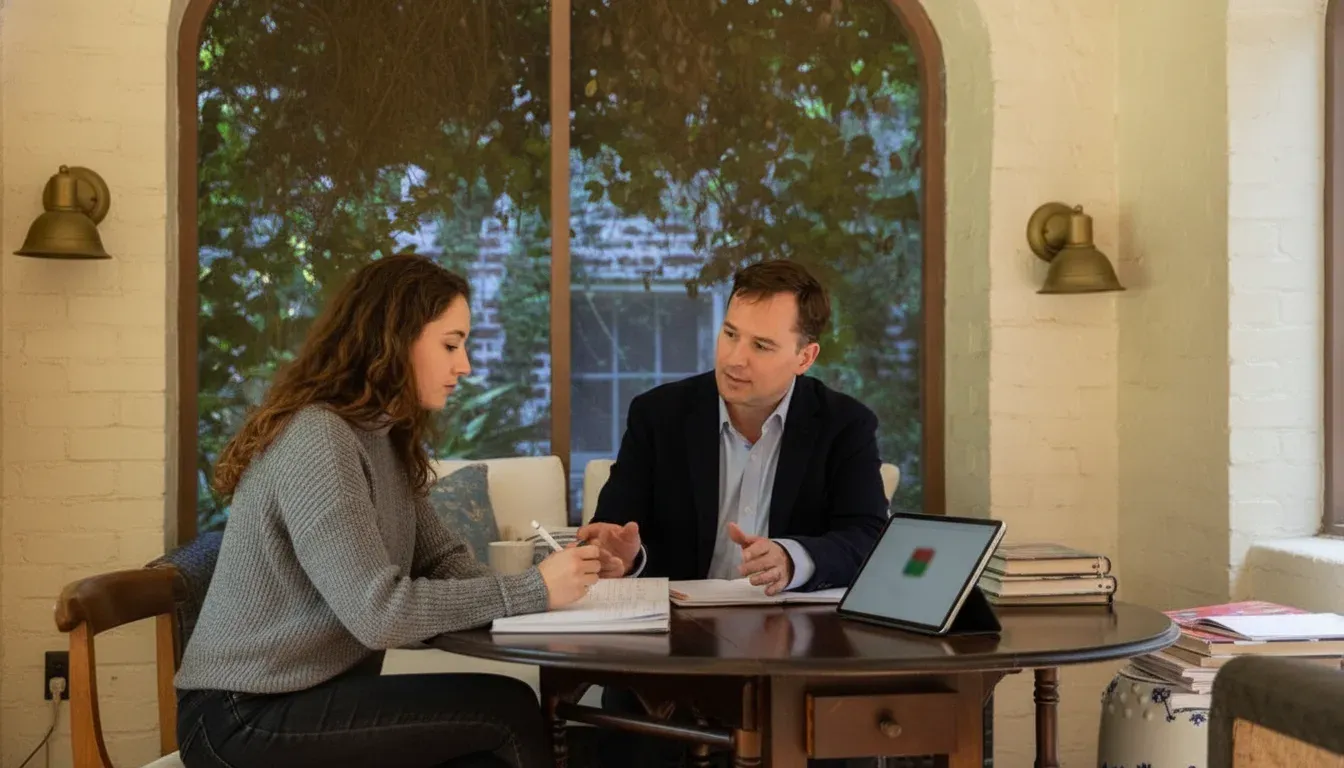
Keep a running error log for at least several sessions. A single missed question can be noise. A repeated pattern across new questions is evidence. If the same error appears in both untimed and timed work, the problem may be a content or reasoning gap. If accuracy is strong without a clock but falls under time pressure, pacing and decision control deserve more attention.
For a complementary habit, see Northside's GRE Question of the Day study routine. Use that page for a daily practice approach, not as a substitute for the broader timed baseline described here.
When should practice results lead to GRE tutoring?
Consider targeted GRE tutoring when your practice log shows a repeated pattern that self-study has not corrected, when timing prevents you from showing what you know, or when you cannot identify the cause of your errors. Tutoring is most useful when it addresses a defined need rather than replacing all independent practice.
Free questions can support self-study when your errors are occasional, your review notes are becoming more specific, and your accuracy improves on new questions. You may need more structure when your results remain flat even though you are completing more problems. More volume cannot reliably fix an unclear diagnosis.
| What your log shows | Likely issue to investigate | First response |
|---|---|---|
| Misses repeat in one concept | Content gap or incomplete method | Review the concept, then retest with fresh questions |
| Untimed accuracy is strong, timed accuracy drops | Pacing, triage, or decision control | Practice timed sets with a plan for hard items |
| Correct answers have low confidence | Unstable reasoning or weak verification | Explain the answer aloud and identify the decisive evidence |
| Errors look random and you cannot explain them | Review process is not yet diagnostic | Ask a tutor to model error classification and next-question selection |
| Performance varies sharply by measure | Uneven preparation needs | Split the plan by Verbal, Quantitative, and writing priorities |
Northside's GRE tutoring program is designed for personalized preparation across the test's core measures. A useful first conversation should include your practice log, target timeline, prior scores if available, and the question types that create the most uncertainty. You can review current options on the pricing information page before deciding on a format, and the Northside FAQ provides additional answers about the tutoring process.
Graduate applicants often balance test preparation with demanding coursework, applications, and work. If you need help organizing the broader process, Northside also offers college essay writing and editing. That service does not replace GRE tutoring, but it can keep separate admissions tasks from competing for the same limited study time.
How can Northside turn practice data into a GRE study plan?
Northside can use your practice evidence to shape a more focused GRE plan around the skills, habits, and timing patterns that matter most. The aim is not to assign random extra questions. It is to connect diagnosis, instruction, deliberate practice, and review in a repeatable feedback loop.
That approach begins with a conversation about your goals and constraints. A tutor can compare the question log with your explanation, identify the first point where reasoning changed direction, and choose the next exercise to test that diagnosis. The work can then become more precise:
- Verbal practice can separate vocabulary knowledge from sentence logic, passage structure, evidence, and distractor analysis.
- Quantitative practice can separate a missing concept from translation, setup, calculation, estimation, and time management.
- Analytical Writing preparation can focus on planning, claim development, evidence, organization, and revision habits.
- Timed practice can test whether a new strategy survives realistic pressure.
- Review can close the loop by checking whether the next set improves the exact pattern you targeted.
Northside's model also emphasizes a personalized learning path rather than a one-size-fits-all worksheet sequence. Learn more about the company's approach to tutoring, meet the Northside tutoring team, or read student and family testimonials before you schedule a conversation. If you are still weighing graduate admissions tests, the GRE versus GMAT comparison can help you frame that decision.
Students who need flexible support can ask about online options through the locations and online tutoring information. Northside also supports adjacent academic needs through math tutoring and English tutoring, which may be useful when GRE preparation exposes a broader academic skill gap. Read about adaptive learning in education to see how a data-informed study path can adjust as your practice evidence changes.
Talk with Northside Tutoring about your GRE practice results and the right next step.
Frequently Asked Questions About Free GRE Practice Questions
Where can I find free GRE practice questions?
Start with the official ETS preparation library and POWERPREP resources, then use other practice sets only when they clearly identify the question type and provide explanations. Official material is the best anchor for format familiarity. Focused third-party practice can supplement it when you are repairing a defined skill.
How many free GRE practice questions should I do at once?
Use enough questions to reveal a pattern, but not so many that you cannot review them. A short, balanced baseline is often more useful than a large untimed question bank. Choose the size based on your goal, then record accuracy, timing, confidence, and error cause.
Should I do GRE practice questions timed or untimed?
Use both. Untimed work helps you learn the question type and see whether you can build a sound solution. Timed work shows whether you can make accurate decisions under pressure. Begin untimed when the format is unfamiliar, then add timed sets as your review becomes more consistent.
Can free GRE practice questions replace a tutor?
They can support independent preparation, but they do not always explain why a pattern is repeating. A tutor becomes more valuable when you cannot classify your errors, your timing causes avoidable misses, or your self-study has stalled despite consistent effort. Bring your log to the first session.
What should I write down after missing a GRE question?
Record the question type, result, confidence, time used, first point of failure, correction rule, and the next question you will use to retest the skill. This turns a missed question into a decision about what to practice next instead of a vague reminder to study harder.
Request a GRE tutoring conversation with Northside Tutoring and bring your practice-question log.
Ready to begin?
Start tutoring with Northside.