
What Students Should Know About Science ACT Test
Schedule focused ACT Science preparation with Northside Tutoring. Learn how to read data, evaluate experiments, and build an effective practice plan.

The science act test rewards students who can interpret evidence, read charts, and make careful decisions under time pressure. Your child does not need to know every scientific fact in advance; a steady method for using the information provided can make unfamiliar passages more manageable.
Request a consultation about ACT preparation
What does the ACT Science test measure?
In brief: ACT Science asks students to interpret data, understand investigations, and compare scientific explanations. Questions draw on passages, charts, tables, and experiment descriptions. The useful first step is to identify what the question asks, then find the evidence that answers it. Reviewing the official ACT Science Test description can help families understand the section's scope and format.
A student may know course science well and still lose time when information is dense or displayed in an unfamiliar way. Another student may be able to reason through an unfamiliar topic by reading the labels carefully. During review, distinguish a science-content gap from a reading or evidence-selection error. Those problems call for different practice.
For instance, if a question asks which sample had the highest measured rate, knowing a theory about the process may not help. The student needs to locate the correct series, check its units, and compare the values. If a question asks why a pattern occurred, the passage may provide competing explanations that must be evaluated separately.
How should students read ACT Science data?
Read the question, locate the relevant display, translate its evidence into plain language, and test the answer against the display. This keeps students from trying to absorb every detail before they know which details matter.
- Identify the task. Is the question asking for a value, trend, comparison, prediction, or conclusion?
- Find the right display. Use the title, axis labels, legend, and table headings. A passage can include several figures with different purposes.
- Check scale and units. Confirm whether the axis begins at zero, whether intervals are equal, and whether the unit is grams, seconds, degrees, or another measure.
- Say what the evidence shows. For example, “As light intensity increases, the recorded growth rises through the first three conditions.” Avoid adding an explanation not shown in the data.
- Compare every answer choice. Reject a choice that reverses a trend, confuses two variables, or makes a stronger claim than the evidence allows.
Consider a table listing plant growth at several light levels. If asked which condition produced the greatest growth, locate the growth column, compare the entries, and report the condition attached to the largest value. Do not assume the highest light level must produce the highest growth. The table, not an expectation, determines the answer.
Graph scale can disguise the size of a change. Imagine a vertical axis that begins at 40 rather than zero. A small difference may look dramatic because the displayed range is narrow. Students should read tick marks instead of judging only the steepness of a line. When the answer asks how much a value changed, subtract the relevant values; when it asks which is greater, a direct comparison may be enough.
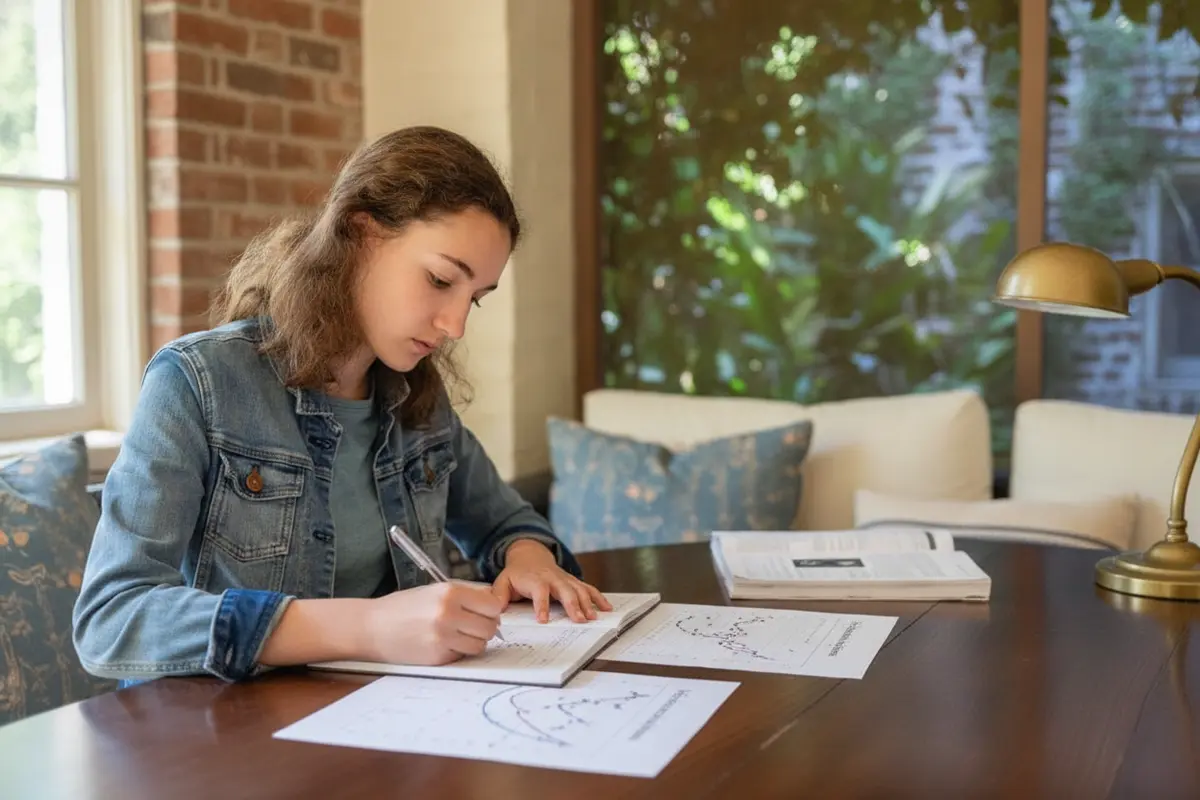
A useful practice drill is to cover the answer choices and describe the display first. The student can state the trend, point to the supporting values, and then uncover the choices. This reveals whether the difficulty lies in understanding the graph or in being distracted by plausible wording.
How do experiments and variables appear on the test?
Identify what researchers changed, what they measured, and what they held constant before deciding whether a conclusion is supported. These details show what comparisons an investigation can fairly make.
- Changed variable: the condition researchers vary across trials or groups.
- Measured outcome: the result recorded to see whether it changes.
- Controlled conditions: factors kept consistent to make comparisons more meaningful.
- Comparison group: a reference condition that helps show what happened when a factor changed.
When two experiments produce different results, compare their procedures before comparing outcomes. One may use a different sample size, temperature, duration, or measurement method. A question about whether one factor caused a result depends on whether the study design makes that explanation reasonable. If several factors changed at once, the evidence may not isolate one cause.
Separate observation from explanation. “The sample changed color” reports an observation. “The added solution caused the color change” is a causal explanation. The second statement needs evidence from the procedure and comparisons. Students should ask, “What was actually measured?” and “What alternative could also account for this result?”
To practice, ask your child to complete this sentence for each experiment: “Researchers changed __, measured __, and kept __ consistent.” Then ask what conclusion the experiment supports and what conclusion would go too far. A concrete example helps: if researchers vary the amount of fertilizer, measure plant height after two weeks, and keep light and water consistent, the comparison speaks to the relationship between fertilizer amount and height in that setup. It does not automatically establish what would happen for every plant or growing condition.
How can students compare scientific viewpoints?
Track each viewpoint separately, then identify the precise claim or assumption that differs. Students need not decide which researcher is right unless a question asks them to evaluate the evidence.
A quick note grid can keep names and claims from blending together:
| What to track | Viewpoint A | Viewpoint B |
|---|---|---|
| Main claim | What explanation is proposed? | What alternative explanation is proposed? |
| Evidence | Which result or observation is cited? | Which result or observation is cited? |
| Difference | What assumption or interpretation separates the views? | |
Suppose two students interpret the same pattern differently. One says a change in temperature affected the result; the other says the difference came from the sample size. A strong answer identifies which evidence would distinguish those explanations. An answer that merely sounds scientific but does not test either claim is not responsive.
During practice, underline the words that express each claim, such as “because,” “increases,” or “only when.” Then map a question to the claim it refers to. If it asks what would support Viewpoint A, look for a finding that directly tests A's proposed mechanism, rather than a result consistent with both views.
How should students manage time and passage order?
Choose an order and pace using timed practice results, not a universal rule. Some students feel comfortable starting with data displays; others work best by following the printed order. The more useful approach is the one that maintains accuracy and leaves a workable amount of time for the full section.
Compare three methods across separate practice sets: follow the printed order, begin with the most accessible passage, or answer questions that point directly to a table or figure before returning to dense explanations. Keep other conditions similar when comparing the methods. After each set, record questions completed, accuracy, and where time went. One unusually easy or difficult set is not enough to establish a preference.
- If a question requires repeated rereading, mark it and move on when the practice format allows.
- Do not give every passage the same amount of time if your results show that formats differ for you.
- Save a short check at the end for unanswered items and misread labels.
- Note whether slowdowns came from arithmetic, locating evidence, vocabulary, or uncertainty between choices.
A pacing log can make a vague concern actionable. Instead of writing “I ran out of time,” a student might record: “I spent too long rereading the introduction on the second passage and did not check the units on the last graph.” The next session then has a specific target: skim for the experiment setup, return to the introduction only when a question requires it, and verify units before comparing values.
Students should also decide in advance what to do when a calculation becomes lengthy. Estimate whether the question needs an exact result or only a comparison. If two values are clearly far apart, careful inspection may be enough; if they are close, calculate and check the arithmetic. A planned decision reduces the temptation to spend several minutes on one item.
What practice plan builds ACT Science skills?
Build from reviewed skill drills to timed mixed practice, and use errors to choose the next assignment. Repeating questions without understanding why an answer works can preserve the same habits.
- Set a baseline. Complete a representative timed set. Record accuracy, completion, and the question types that felt difficult.
- Classify errors. Mark each missed or uncertain item as data reading, experiment design, viewpoint comparison, calculation, passage comprehension, or pacing.
- Choose one skill. Practice one small process, such as reading units or identifying the changed variable, before adding time pressure.
- Review the evidence. For each corrected answer, point to the sentence, value, or procedure that supports it. Explain why the closest distractor fails.
- Return to mixed practice. Revisit similar questions later and check whether the method still works when formats change.
Here is a worked review example. A student misses three questions in a set. The first mistake comes from reading the wrong line in a graph; the second from assuming an experiment proves causation; the third from spending too long on an unfamiliar term. Treating all three as “science mistakes” would lead to unfocused studying. Instead, practice tracing a graph legend, separating observation from explanation, and using context clues or moving on when a term is not essential.
Keep an error log with four columns: question type, what the student did, what the evidence required, and the next practice move. After several sets, patterns become clearer. If the student consistently understands the data but loses time searching through long introductions, the strategy needs adjustment. If they find the right figure but misread units, careful display checks deserve more attention.
Families can make practice supportive by asking the student to explain their reasoning before correcting it. “Show me where you found that” invites evidence-based review. It also helps your child see that a wrong choice can reveal a specific skill to work on, rather than serving as a judgment about ability.
Students preparing for the full exam can connect this work with ACT Science preparation and broader test prep tutoring. A student who wants to strengthen quantitative reasoning can also review math tutoring, while a course-content need may point to science tutoring.
What should families compare when choosing ACT support?
Look for support that explains the source of errors and gives your child a way to practice the skill again. Families can compare format, feedback, scheduling, and how progress is reviewed before choosing a plan.
| Support option | May fit when | Questions to ask |
|---|---|---|
| Independent practice | The student is organized and can review mistakes carefully. | Can the student explain why the answer is supported and why alternatives fail? |
| Small-group preparation | The student benefits from shared instruction and structured practice. | How will individual errors receive attention? |
| One-on-one tutoring | The student needs individual pacing or targeted review. | How will sessions respond to the student's practice results? |
Ask how a provider distinguishes a content question from a data-reading problem, when timed work is introduced, and how the student knows what to practice between sessions. A useful plan should be clear to the student and family, with feedback that points to a concrete next step instead of simply reporting right and wrong answers.
Families can review Northside's approach, tutoring team, family testimonials, and pricing information. The online tutoring option and location information can help you compare formats. For more details, consult the student and parent resources and frequently asked questions.
For context across admissions tests, Northside also offers SAT tutoring, SSAT tutoring, and HSPT preparation. Families seeking a broad starting point can visit the Northside Tutoring home page or use its contact page to discuss their child's needs.
Talk with Northside about your child's ACT preparation
Frequently asked questions about the science ACT test
Does ACT Science require advanced science knowledge?
The section emphasizes interpreting information and reasoning from evidence. Basic familiarity with scientific language can help, but students should read each passage and use the data provided rather than assuming they must memorize advanced material.
Should students read the entire passage before answering?
It depends on the passage and the student. Reading the question first can point to a relevant chart or procedure, while other questions require context from the explanation. Compare approaches in practice and use accuracy, not habit, to choose.
How can a student improve graph-reading accuracy?
Check the title, labels, units, scale, and legend. Describe the trend in plain language, locate the supporting values, and verify that the selected answer matches what the graph shows.
How often should students practice?
A manageable schedule that includes review is more useful than repeated sets without analysis. Frequency depends on the test date, time available, and the student's needs; consistency and thoughtful correction matter.
Make the next practice session more focused
Start with one timed set, classify each missed or uncertain answer, and choose a single skill for the next session. When your child can explain the evidence behind an answer and the reason a tempting alternative fails, practice becomes a learnable process rather than guesswork.
Ready to begin?
Start tutoring with Northside.