Organic Chemistry Tutor: What to Look For
Get practical guidance on choosing an organic chemistry tutor, what to ask, and how Northside Chemistry tutoring can support your student with confidence.
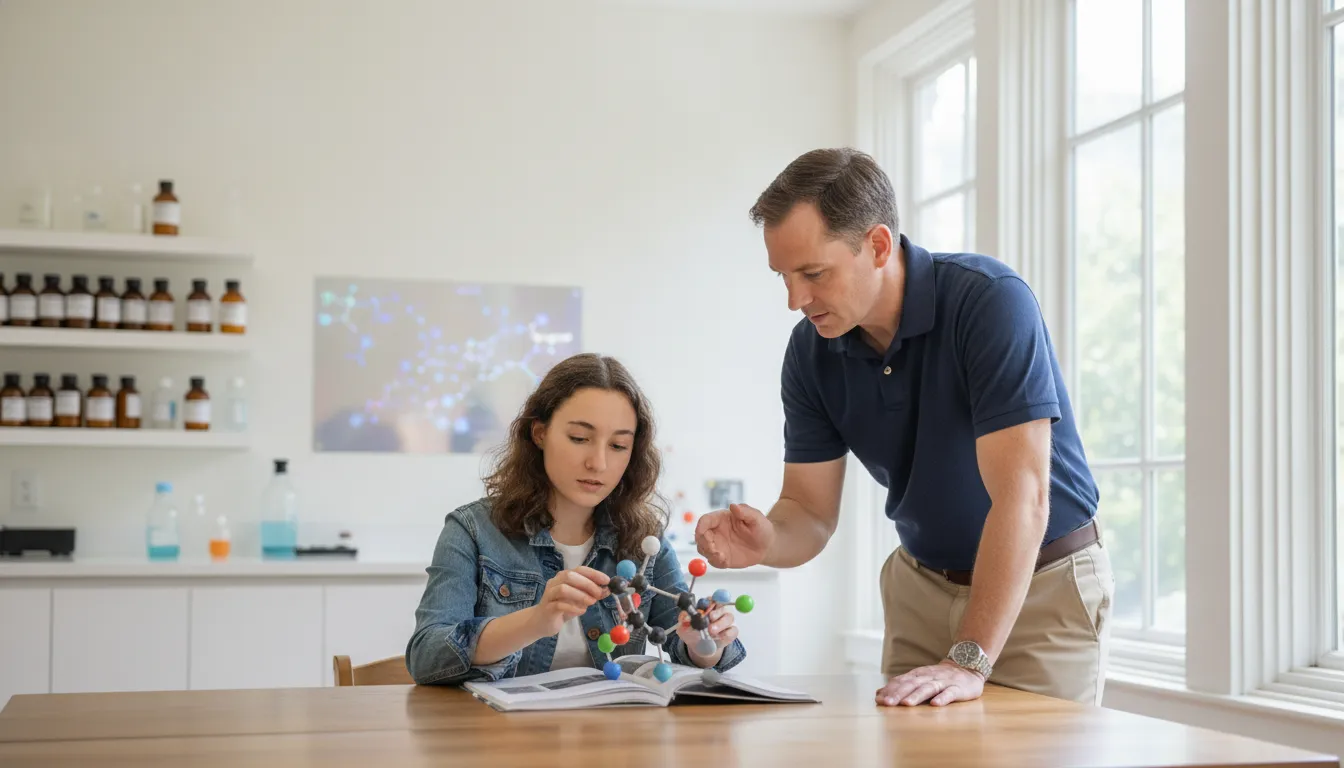
Organic chemistry can feel less like memorizing reactions and more like learning a new language. Students are often expected to interpret structures, connect mechanisms, and solve unfamiliar problems while keeping pace with lectures and labs. The right support should make that reasoning visible, not simply provide another set of answers.
Explore Chemistry tutoring at Northside.
An effective organic chemistry tutor helps students identify prerequisite gaps and understand why reactions work. Practice with guidance can build a repeatable approach to mechanisms, stereochemistry, spectroscopy, and synthesis.
For families comparing options, the key question is not whether a tutor can explain a difficult reaction once. It is whether the tutor can diagnose how the student is thinking, adapt explanations to that need, and build independent problem-solving habits. That evaluation begins by clarifying the practical work a strong tutor should help a student do during and between sessions.
What Does an Organic Chemistry Tutor Help a Student Do?
An effective organic chemistry tutor helps a student replace answer-dependent studying with a repeatable process for interpreting structures, choosing reactions, explaining mechanisms, and checking the result.
The difference matters. An answer-giving session may get a worksheet finished. But it does not necessarily help a student recognize why a reaction works or decide what to try on a new problem. A stronger tutor asks the student to predict, draw, explain, and revise. The goal is transferable reasoning that remains useful when the professor changes the molecule, reaction conditions, or question format.
Organic chemistry is widely recognized as challenging, particularly when students must plan a synthesis or retrosynthesis. In a synthesis problem, the student connects a series of reactions to create a more complex target molecule, drawing on functional-group knowledge and prior learning. This academic review of organic chemistry learning describes why those tasks require integration rather than simple recall.
From mechanisms to molecular decisions.
During guided practice, a tutor can help a student slow down the decision points that are easy to skip.
- Mechanisms: identify the electron source, electron sink, bond changes, and conditions before memorizing a product.
- Stereochemistry: track three-dimensional relationships, configuration, and the consequences of attacking one face of a molecule rather than another.
- Spectroscopy: connect signals and patterns to a plausible structure instead of matching one isolated peak from memory.
- Synthesis: work backward from a target, identify strategic bond disconnections, and test whether the proposed sequence is chemically reasonable.
This is not a request for the tutor to lecture through an entire textbook. It is a way to locate the exact point where reasoning breaks down, then give the student enough structure to solve the next problem independently. A student who confuses acid-base steps may need different support from one who understands mechanisms but cannot visualize stereochemistry.
Mapping prerequisites before adding more practice
Many apparent organic chemistry problems begin with an earlier gap in bonding, resonance, molecular structure, equilibrium, or functional groups. A useful tutor checks those prerequisites instead of assigning increasingly difficult questions at random. The result should be a focused plan connected to the student's course, labs, and upcoming assessments.
Families evaluating this kind of support can compare Chemistry tutoring with more specific college organic chemistry support and review practical questions about choosing an online chemistry tutor. The best choice is not simply the person who can solve the hardest problem. It is the tutor who can reveal the student's reasoning, respond precisely, and gradually make that reasoning their own.
When Should a Student Consider Organic Chemistry Tutoring?
Consider an organic chemistry tutor when confusion has become a pattern rather than a single difficult assignment. The right support can identify whether the obstacle is a missing prerequisite, an unclear representation, or weak problem-solving habits. It can also address a course moving faster than the student can process.
Are the same errors appearing across different problems?
Repeated mistakes deserve more attention than a disappointing quiz score. A student may know individual reactions but miss the same charge, fail to track electron movement, or choose a reaction by memorization instead of recognizing the underlying pattern. Review the work together and look for errors that recur across mechanisms, stereochemistry, spectroscopy, or synthesis questions. A tutor should ask the student to explain each decision, not just provide a corrected answer.
Can the student connect different representations?
Organic chemistry asks students to move between structures, molecular geometry, reaction arrows, names, spectra, and written explanations. If a student can repeat a definition but cannot connect a line-angle structure to what happens in a reaction, that gap is a useful signal. The same applies when lecture notes make sense in isolation but practice problems feel unrelated. A diagnostic conversation should test coherent understanding and reveal which connections need to be rebuilt.
Is the course or lab schedule leaving no room to recover?
Waiting until the week before an exam often turns every unresolved question into an emergency. Consider tutoring when lectures, problem sets, and lab preparation are competing for the same limited time. Early support can help a student prioritize the concepts that matter for the current course, plan practice around lab deadlines, and bring specific questions to each session. It is also reasonable to seek help before a crisis when the student feels unsure what to practice or cannot tell whether an answer is actually well supported.
Chemistry education research emphasizes defining what students should know, checking whether their understanding is coherent, and using evidence to build deeper understanding. That learning-evidence framing supports tutoring that diagnoses reasoning, gives targeted feedback, and adjusts practice rather than simply adding more worksheets.
Students can supplement instruction with chemistry video learning resources, but videos cannot always identify why a particular solution breaks down. Families comparing broader science tutoring options should ask whether the tutor can address organic chemistry specifically. They should also weigh chemistry tutoring cost factors alongside diagnostic depth, scheduling, and fit.
How Can Families Compare Organic Chemistry Tutoring Options?
Answer: The strongest choice is not automatically the most convenient or most advanced-looking option. It is the support that identifies the student's actual gaps, explains organic chemistry visually and logically, and gives useful feedback on the student's own problem-solving process.
| Option. | Fit. | Feedback. | Diagnostic depth. | Best use. |
|---|---|---|---|---|
| Self-study and video resources. | Useful for a focused question or reviewable topic. | Usually delayed or self-directed. | Limited unless the student can accurately identify the gap. | Reinforcing class notes, vocabulary, and worked examples. |
| General subject tutoring. | Helpful when foundational chemistry or study habits are the main issue. | Depends on whether the tutor watches the student's reasoning. | May identify broad course weaknesses without separating organic chemistry skills. | Prerequisite repair, homework structure, and general course support. |
| Specialized organic chemistry tutoring. | Best when mechanisms, stereochemistry, spectroscopy, or synthesis are central. | Should be immediate, specific, and tied to the student's work. | Can examine how the student reads structures, selects reactions, and connects representations. | Course recovery, deliberate practice, and exam preparation. |
Families should ask whether the tutor can do more than explain a correct answer. Organic chemistry often requires students to connect structures, mechanisms, reaction patterns, and three-dimensional relationships. A strong organic chemistry tutor should ask the student to predict, justify, draw, and revise, rather than taking over the problem.
Visualization matters, especially when a student is struggling with chirality, reaction intermediates, or the relationship between a molecular structure and its representation on the page. Digital whiteboards, molecular modeling tools, and clear hand-drawn mechanisms can make an abstract explanation more concrete. The tool matters less than whether it helps the student reason independently afterward.
Also evaluate flexibility and follow-through. Can sessions fit around coursework and labs? Will the tutor assign targeted practice instead of generic worksheets? Does feedback address the pattern behind an error? Will exam support include mixed problems and time-management decisions, not only a review of missed homework?
For broader context, compare this section with Northside's student-centered approach, review the Northside tutor team, and consider family experiences as one part of your evaluation. None should replace a direct conversation about the student's course, current work, learning preferences, and immediate goals.
Talk with Northside about a course-specific Chemistry tutoring plan.
What Should an Effective Organic Chemistry Tutoring Plan Include?
Answer: An effective plan begins with a diagnostic baseline, prioritizes the concepts that control current coursework, and then combines guided problem solving with spaced practice and regular adjustment. The goal is not to complete more worksheets. It is to help you explain why a reaction proceeds, recognize patterns in unfamiliar problems, and make decisions independently.
- Baseline and prerequisite check. Start by reviewing recent assignments, quizzes, lab expectations, and the course calendar. A tutor should identify whether the immediate difficulty involves organic chemistry itself or a prerequisite gap in bonding, acid-base reasoning, resonance, functional groups, or three-dimensional structure. The baseline should also ask you to explain your reasoning aloud, not merely report an answer. That distinction reveals whether an error is conceptual, procedural, or caused by rushing.
- Priority concepts tied to the course. Build a short sequence around the next meaningful academic demands. Depending on the class, that may include reaction mechanisms, stereochemistry, spectroscopy interpretation, or synthesis and retrosynthesis. Use molecular drawings and models when a spatial idea is difficult to see. The plan should connect each new reaction to the patterns that make it predictable, rather than treating every reaction as an isolated fact. Scheduling should account for lectures, problem sets, exams, and lab assignments so tutoring reinforces the course instead of competing with it.
- Guided problem solving. Early sessions should model a process, then transfer responsibility to the student. For a mechanism, that might mean identifying the nucleophile and electrophile, tracking electron movement, and checking charge and atom conservation. For spectroscopy, it might mean combining evidence from multiple signals instead of matching one peak to one memorized answer. For synthesis, the tutor can work backward from the target and ask which transformation would create the needed bond. The student should do enough of the work to develop judgment, with prompts replacing answer-giving.
- Spaced and mixed practice. Revisit important ideas across multiple sessions, then mix mechanism, stereochemistry, spectroscopy, and synthesis problems once the foundations are secure. Include problems that resemble current coursework as well as unfamiliar applications. This exposes whether the student can select an approach without being told which chapter or reaction applies. Keep a brief error log that records the decision that failed and the correction that worked.
- Feedback and adjustment. End each session with specific feedback, a manageable practice assignment, and a clear next step. Review the work at the next meeting and adjust the plan based on evidence, not assumptions. A student who can complete routine mechanisms but cannot transfer the reasoning to synthesis needs a different emphasis than a student still rebuilding prerequisite knowledge. Families can also use academic resources, review tutoring FAQs, or contact Northside to discuss a course-specific plan.
What Questions Should You Ask Before Choosing a Tutor?
Answer: Choose an organic chemistry tutor who can diagnose how the student thinks and explain difficult material in more than one way. The tutor should also show how sessions will build independent problem-solving skills.
A polished profile is not enough. Ask questions that reveal what the tutor will do when a student cannot predict a reaction. Ask how the tutor addresses lost stereochemistry or memorized steps without understanding.
What relevant chemistry expertise do you bring?
Ask whether the tutor regularly supports the student's course level and topics, including mechanisms, synthesis, spectroscopy, or prerequisite chemistry. The answer should connect expertise to the student's actual syllabus rather than rely on broad claims. If the student is taking AP, advanced, or college chemistry, ask how the tutor will coordinate support with current assignments, labs, and exams.
How will you identify what is actually going wrong?
A useful first session should do more than review a list of missed questions. Ask whether the tutor will examine the student's work, ask diagnostic questions, and distinguish a content gap from a reasoning or study-process issue. Families should leave with a clear sense of what the student knows, what needs attention first, and how progress will be checked.
How do you explain difficult ideas?
Ask for an example of how the tutor would explain a mechanism or a three-dimensional structure to a student who is stuck. Strong instruction may move between words, structures, drawings, and guided questions. It should require the student to reason through a problem, not simply watch the tutor produce an answer.
What will sessions look like between assessments?
Clarify whether sessions are one-on-one or small-group, online or in person, and how practice and feedback will be handled. Ask how communication works when a student has a question between meetings, and what information parents receive. You can also review current tutoring options and Northside's academic guides as you compare the practical fit of different support plans.
How will we know the match is working?
Ask what evidence the tutor will use: clearer explanations, fewer repeated errors, stronger transfer to unfamiliar problems, completed practice, or more productive study habits. Avoid promises of a particular grade or outcome. The right match should support confidence, work ethic, and critical thinking while adapting to the student's learning style, schedule, needs, and course demands.
Explore Northside Chemistry tutoring and discuss the right fit.
How Does Northside Chemistry Tutoring Support Students?
Northside Chemistry tutoring supports students by matching them with an appropriate tutor and adapting instruction to their course level and learning needs. It also provides a practical format for consistent support. Chemistry help can begin with foundational or remedial work and extend through advanced and AP-level instruction. That range matters when a student is not sure whether the main problem is a missing prerequisite, a difficult unit, or the pace of the current class.
Northside offers one-on-one and small-group tutoring. Students can work online or in person, depending on location and scheduling needs. In-person service is available across Greater Atlanta. Online instruction makes it possible for students outside that area to access tutoring, without implying that Northside provides in-person service nationwide. Families can review the documented options on the Northside Chemistry tutoring page.
Robert Feagin personally considers subject expertise, personality compatibility, learning style, schedule, and the student's specific needs when matching a student with a tutor. That process recognizes an important reality: the strongest academic fit is not defined by a resume alone. A student may need a tutor who slows down explanations, asks better diagnostic questions, or creates enough structure to turn practice into a dependable habit.
Northside describes its model as student-centric, with attention to academic performance, confidence, work ethic, and critical-thinking skills. Sessions should therefore address more than getting through the next assignment. They can help a student explain reasoning, identify where a process broke down, and approach future problems with greater independence. Families comparing providers may also find it useful to review Northside's guidance on college organic chemistry support.
Robert's view is straightforward: tutoring works best when the student and tutor are matched intentionally, then given a clear understanding of what needs attention next. If your child needs chemistry support, start by discussing the course level, current challenges. Preferred format, and schedule with Northside so the recommended path reflects the student's actual situation.
Frequently Asked Questions
What should I look for in an organic chemistry tutor?
Look for subject expertise, clear explanations, and a willingness to make you solve problems rather than simply watch solutions. A strong tutor should diagnose prerequisite gaps, connect molecular representations to mechanisms, and give specific feedback on your reasoning. Ask how the tutor will adapt sessions to your course topics, laboratory schedule, and upcoming assessments.
Can tutoring help if I understand the lectures but miss exam questions?
Yes. That pattern often means you need guided practice applying concepts, not another summary of the lecture. A tutor can examine where your reasoning breaks down, such as identifying the reacting site, predicting stereochemical outcomes, interpreting spectra, or choosing a synthesis route. The goal is to make your problem-solving process more deliberate and transferable.
Should organic chemistry tutoring focus on homework or exam preparation?
It should connect both. Homework can reveal misconceptions early, while exam-style problems test whether you can select and combine ideas under time pressure. An effective plan uses current assignments to build understanding, then adds mixed practice and feedback so you can handle unfamiliar questions without relying on memorized answer patterns.
Is online organic chemistry tutoring effective for visual learners?
It can be effective when sessions use a shared workspace to draw structures, show movement of electrons, compare conformations, and work through problems interactively. The format matters less than whether you are actively explaining your choices and receiving immediate correction. If you learn best in person, ask whether local sessions are available before choosing a provider.
How does Northside match students with a chemistry tutor?
Northside considers subject expertise, personality compatibility, learning style, schedule, and individual needs when matching a student with a tutor. Chemistry support is available one-on-one or in small groups, online or in person across Greater Atlanta. Families can discuss the student's course, current challenges, and preferred learning format through the Chemistry tutoring service.
Ready to find the right organic chemistry support?
Effective tutoring should help a student understand how ideas connect, practice with purpose, and receive feedback that shapes the next step. If you are comparing options for yourself or your child, explore Northside's Chemistry tutoring options and contact the team to discuss the student's organic chemistry needs. A brief conversation can help clarify the best format and focus for the support ahead.
Ready to begin?
Start tutoring with Northside.