
How to Read Test Questions
Start with how to read test questions: mark the stem, units, and traps before you choose. Book a Northside test-prep consult today.

A student who knows the material can still miss the point because the first read was too fast. Learning how to read test questions means marking the verb, the exception, and the unit before any answer looks tempting. The score moves when that first pass is a habit, not a lucky slowdown on one item.
Book a consultation to have a Northside tutor watch how your child reads a stem.
Northside already published a full plan for test taking strategies. That guide owns pacing, elimination, guessing, and the error log. This article stays on one earlier decision: what the question is actually asking. Parents can use the steps below on tonight's homework set. A tutor uses the same steps when a missed item was a reading miss, not a content miss.
How to Read Test Questions Before You Touch an Answer
Read the stem to the period, name the job in four words, then look at choices. The job is the verb plus the limit. "Which claim is supported" is not the same job as "which claim is not supported." Students who glance at choices first start defending a familiar phrase. They never finish the sentence that told them what to do.
Use this order on every multiple-choice item, including the ones that feel easy.
- Cover the choices with a hand or a card.
- Read the stem once, out loud if the room allows it, through the last word.
- Underline or box the verb: identify, infer, except, not, best, least.
- Box any number, unit, name, or "according to the passage" limit.
- Say the job in one short line: "find the claim the passage does not support."
- Only then uncover the choices and test each one against that line.
The cover step feels slow for the first ten items. It is faster than rereading a stem after a wrong choice has already anchored the brain. On the digital SAT, each Reading and Writing module gives 32 minutes for 27 questions, so a clean first read still has to be short. College Board publishes that structure on its SAT structure page. The point of the cover is not a long pause. It is one complete sentence before the options speak.
Robert's take: if a student can explain the job and still picks a trap, the miss is content. If the student cannot say the job, more practice problems will not fix it. Stop and reread.
What the Stem Is Asking You to Do
The last verb in the stem is the assignment. Best supports asks for evidence that fits. Most nearly means asks for a word in this sentence, not the dictionary sense the student likes. Primarily asks for the main job of a paragraph, not a true detail from line two.
Sort the verbs your child actually sees into three buckets. Evidence verbs, such as supports, illustrates, and suggests, send the student back to a line. Meaning verbs, such as means, refers, and functions, stay inside one sentence or one paragraph. Exception verbs, such as except, not, and least, flip the search. Mixing those buckets is how a strong reader chooses a true statement that does not answer the asked question.
On ACT English, many items point at an underlined or highlighted spot and ask which choice best accomplishes a goal. ACT describes that work on its section guide: English has 50 questions in 35 minutes, and a topic-development item may ask what the essay would lose if a sentence were deleted. The student who reads only the underlined words misses the goal in the stem. The student who reads the goal can reject a grammatically fine choice that does the wrong job.
A useful parent check takes one minute. Cover the choices on three missed items and ask, "What are you supposed to find?" If the answer is "the right one," the stem was not read. If the answer names the verb and the limit, move on to the choices.
How Except, Not, and Units Change the Job
Circle EXCEPT, NOT, LEAST, and every unit before you compare choices. These words are short, and they reverse the whole item. A student who proves three choices wrong, then selects the fourth, has done the ordinary job. On an EXCEPT item, the right choice is the one that does not belong. The same habit that helps on a normal item produces the wrong letter here.
Units do the same quiet damage in math and science items. A stem that asks for hours will offer a correct-looking number of minutes. A stem that asks for the value after a percent increase will offer the increase alone. The arithmetic can be perfect and the choice still wrong, because the student answered a nearby question.
Read the limit words with the same care as the verb.
- According to the passage means the line has to carry the claim. Outside knowledge does not count.
- Best means more than one choice can be partly true. The winner fits every limit in the stem.
- Least or not means the tempting choice is often the most true statement on the page.
- In line 12 or in paragraph 3 means a true idea from somewhere else is still wrong.
- Per hour, in meters, after tax means the unit in the choice must match the unit in the stem.
Have the student rewrite an EXCEPT stem in plain words before looking down. Which of the following is NOT a cause becomes find the choice that is not a cause. That one sentence stops the automatic hunt for a cause. It also gives a parent something to listen for. If the rewrite drops the word not, stop the item and read it again.
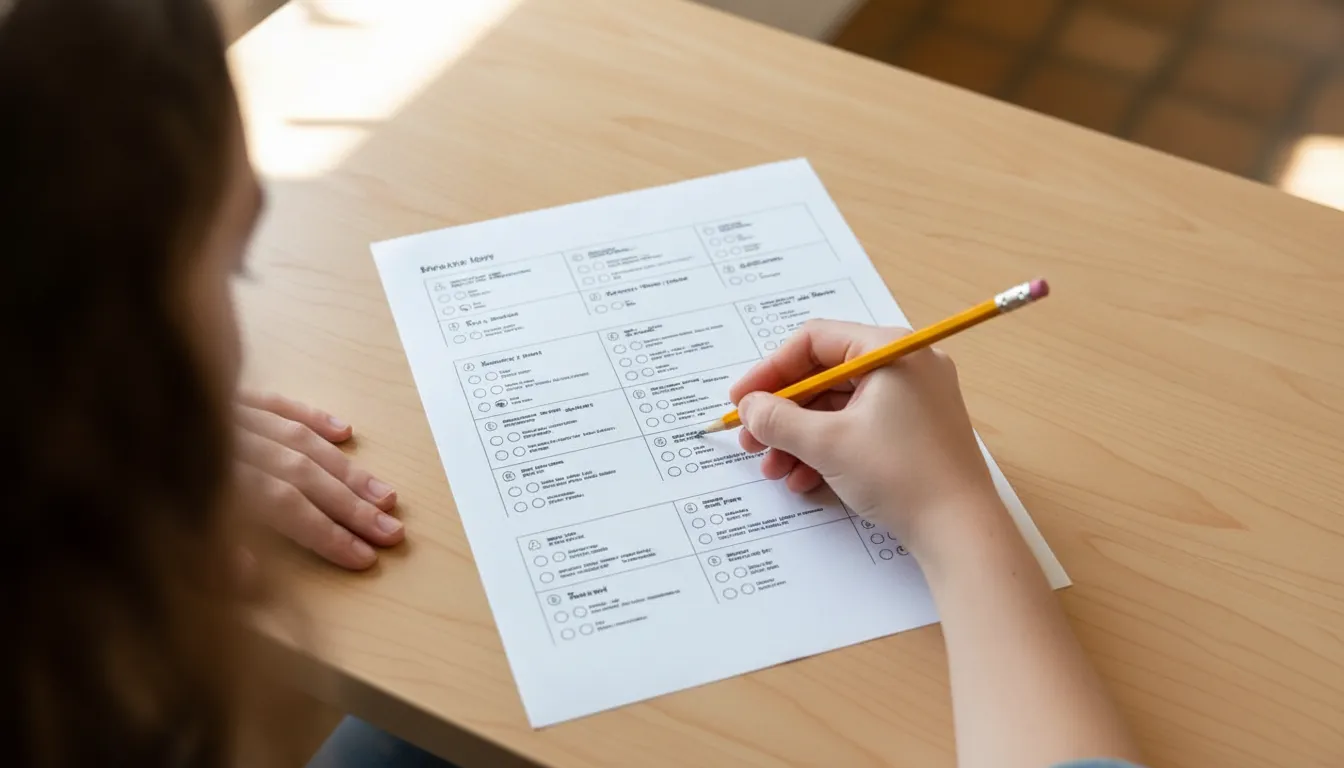
How Charts and Paired Texts Hide the Real Question
Read the stem, then the labels, then the choices. A chart, a paired passage, or a notes list is not the question. Students lose points when they study the figure first and answer the story they think it tells. The stem may ask only which statement the figure supports, or which note should be left out of a sentence with a stated goal.
On a chart item, read three things and ignore the rest until a choice forces you back. Read the title, the axis or column labels, and the stem's verb. Do not scan every bar for a pattern you were not asked to find. A choice that describes a real pattern can still be wrong if the stem asked for a comparison the figure does not show.
On a paired text, the stem usually names the relationship: agree, disagree, respond, or share a method. Students who summarize passage one, then summarize passage two, often pick a choice that is true of only one author. Northside's guide to dual passages goes further into that comparison. For the first read, it is enough to write the relationship in the margin before any choice is tested.
Digital SAT Reading and Writing items are short, and many of them include a note, a sentence to complete, or a small data display. The short length makes a misread more costly, not less. There is less surrounding text to correct a wrong first impression. Say the job, then touch the display.
Three Trap Answers That Copy the Question
A trap that repeats the stem is still wrong if it misses the verb or the limit. This section is not a full method for crossing choices out. Northside's process of elimination guide owns that skill, and the guessing guide owns penalty rules. Here the only question is how a bad first read makes a copied phrase look correct.
| Trap shape | What the student sees | What the stem actually required |
|---|---|---|
| Copied wording | A choice repeats a noun from the line. | The verb asked for a relationship. |
| True but off-job | The statement is accurate. | The stem asked for an exception. |
| Wrong unit | The arithmetic matches one step. | The stem asked for another unit. |
Teach one counter-move for each shape. For copied wording, cover the repeated noun and ask whether the verb is done. For a true but off-job choice, read the limit words again. Ask whether the stem said except, not, or only this paragraph. For the unit trap, circle the unit in the stem and the unit in the choice. Refuse a mismatch. None of these moves replaces knowing the content. They stop a fast reader from buying a familiar phrase.
When two choices remain and both look possible, the student has left the first-read problem and entered a comparison problem. That is the moment to use elimination, not another reread of the same noun. If the clock is the real issue, use the pacing guide instead of adding more words to this checklist.
How the Same Misread Shows Up on Each Exam
The reading habit stays the same, and the stem's costume changes by exam. Do not rebuild a separate philosophy for every test. Change only the words you box.
On the SAT, box "best," "most nearly," and any note that states a goal, such as "the student wants to emphasize a contrast." A choice can be well written and still miss that contrast. SAT math adds student-produced answers, so there is no choice to lean on. The stem's unit is the whole constraint. Families comparing formats can start with SAT tutoring and the digital SAT structure guide for the module layout, not for this reading habit.
On the ACT, English stems often hide the job after the underlined portion: emphasize, add relevant detail, or accomplish a purpose. Reading stems ask for inference or main idea inside a longer passage. Math stems bury "to the nearest tenth" and "in terms of x" at the end. Science, when a student takes it, asks which hypothesis or which table cell the wording points to. The ACT structure guide and ACT tutoring cover the section map. The first-read rule is still: verb, then limit, then choices.
On the SSAT, synonym and analogy items are short enough that students skip the relationship and grab a familiar word. A verbal stem that asks for the pair with the same relationship is failed by a pair that shares a topic. Northside's SSAT verbal strategies page treats those item types in full. For reading, box "except" and the line reference. For a broader admissions plan, start at SSAT tutoring. Check current section times on the official SSAT materials rather than trusting an old blog figure.
Graduate exams use the same first read with denser stems. A GRE or GMAT item may ask which statement must be true, which is an assumption, or which completion fits a blank. An LSAT stem may ask for the flaw, the principle, or the choice that most weakens an argument. "Must be true" is not "could be true." "Most weakens" is not a nearby complaint. Students preparing for those exams can look at GRE prep, GMAT prep, and LSAT prep. The stem skill is the part they can practice on one argument tonight.
What to Fix Tonight After a Misread
Redo three misread items from a blank stem, and do not add a new practice test. A misread is fixed by repetition of the read, not by more pages. This is narrower than a full review system. The practice-test review guide owns error categories and the redo cycle. Use that page when the stack of misses is mixed. Use the steps here when you already know the miss was "I answered a different question."
Pick three missed items. Cover the choices. Have the student write the job in one line, including any NOT or unit. Uncover the choices and eliminate only what fails that line. If the student now sees the right choice, the content was fine and the read was the leak. If the student still cannot do the work, the miss was content, and a reading checklist will not help. Say so plainly and teach the concept.
Keep a three-column note for a week: the verb, the limit that was skipped, and the trap shape. Stop at fifteen rows. A longer log becomes a project and stops being a habit. Parents do not need to invent a curriculum around it. Ask one question when a child says "I knew that." Ask what the stem told them to find.
Nerves can make the first read sloppy, but a breathing routine is a different article. Use Northside's test anxiety guide when the student knows the job and still cannot stay with the sentence. Do not mix that toolkit into this checklist.
One-on-one test prep at Northside is $165 per hour. A 20-hour small-group cohort is $2,780, paid in full or in four monthly installments. Subject tutoring, if the leak is the underlying concept rather than the stem, is $150 per hour one-on-one. Current figures and what each program includes are on the pricing page. Accepted payment methods are credit card processed by Stripe, cash, and check. Northside does not store card numbers.
No admission guarantee. Admission decisions are made solely by schools and colleges. Northside does not and cannot guarantee admission to any school, program, or college, and no Northside statement should be understood as such a guarantee.
Book a consultation if the same misread keeps showing up across SAT, ACT, or SSAT sections.
Frequently Asked Questions
How should a student read a test question the first time?
Cover the choices, read the stem through the last word, and say the job in one line before looking down. The line should include the verb and any limit, such as except, not, or a unit. Then test each choice against that line. The first read is done when the student can state the job without seeing the choices.
Why do students miss questions they understood?
They often answer a nearby question. A true detail, a copied noun, or a correct step in the wrong unit feels familiar, so it gets selected. The stem's verb or a small word such as not was never marked. Rewriting the job in plain words catches that miss before the letter is chosen.
Does this replace a pacing or guessing plan?
No. Reading the stem is the step before timing choices and before a guess. Northside's pacing guide and guessing guide cover those later decisions, including which exams penalize a blind guess. Use this article only to make sure the question being timed is the question that was asked.
How many items should a parent redo in one sitting?
Three is enough. Redo them from a covered stem, and keep a short note of the verb and the skipped limit. A full new practice test adds fatigue and hides whether the read improved. If three redos still fail because the concept is missing, stop the checklist and teach the concept.
When should a family bring a tutor into this?
Bring a tutor in when the same trap shape appears across a week of homework, or when the student cannot tell a reading miss from a content miss. A Northside tutor can watch the first read and separate those causes. Families can book a consultation and compare test-prep options on the test prep page.
Ready to See Real Results?
A careful first read is a small habit with a large payoff. Your child does not need a new stack of tricks. Your child needs a stem that is finished before the choices start arguing.
Bring three missed items to a consultation. A tutor will sort reading misses from content misses and show which Northside plan fits, from one-on-one test prep to a small-group cohort.
Book a consultation and bring the last practice section with you.
Ready to begin?
Start tutoring with Northside.