
Help Me With Geometry: Proofs and Diagrams
Get help me with geometry support for proofs and diagrams. Book a consult. See how a tutor walks the next problem with your child.
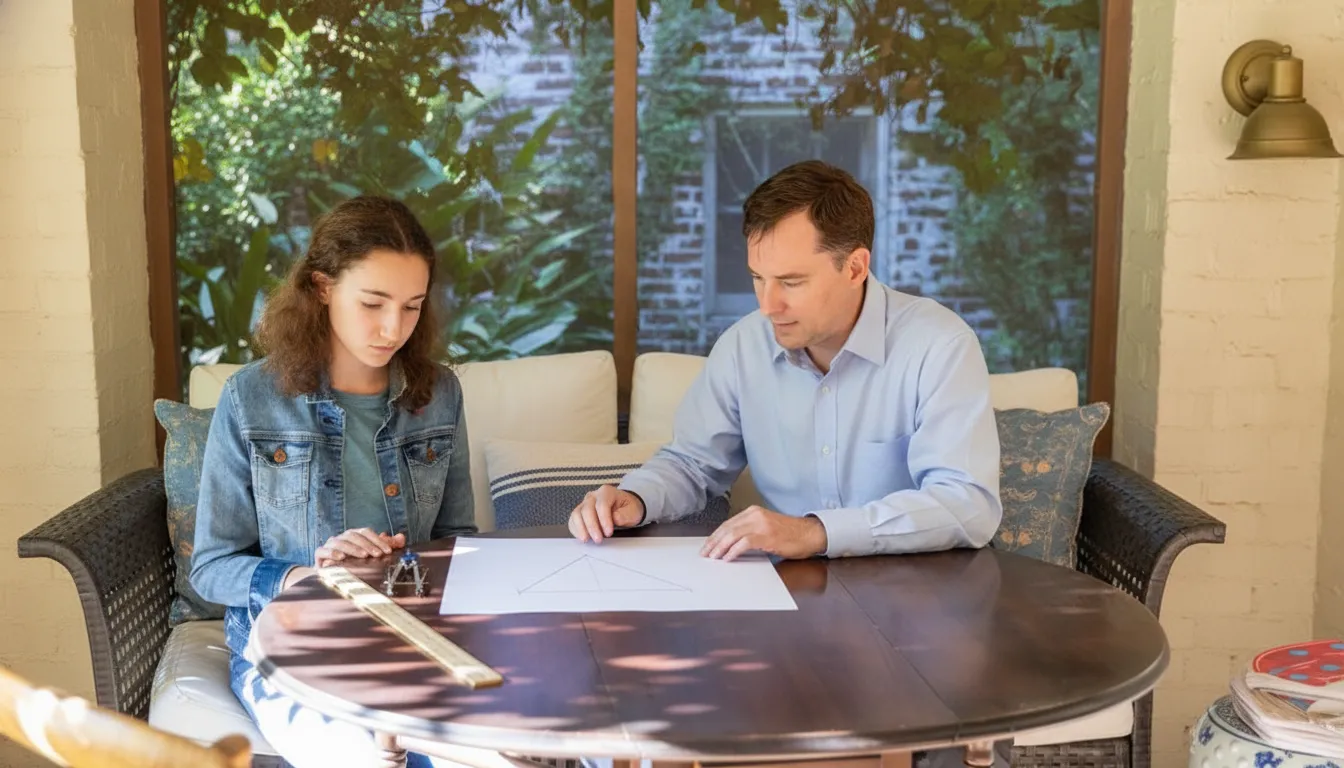
If you searched "help me with geometry" after staring at a proof, the stall is common. Geometry asks you to interpret a figure, name what is given, and defend the next step in writing. A tutor stays with that exact problem until the next line is a choice your child can explain.
Call (470) 779-8999 when the same diagram keeps stopping your child.
A useful session does three things. It reads the diagram carefully, writes one justified step, and checks that the step answers the question the problem actually asked. Northside Tutoring does this work in one-on-one subject sessions in Buckhead and Greater Atlanta, and online across the Southeast.
What Should You Do If You Need Help With Geometry?
Begin with the problem in front of you, rather than a full chapter review. Copy the given statements onto the figure, mark only those facts, and stop at the first line you cannot defend. That stalled line becomes the whole lesson.
Most stalls look like one of these patterns:
- The diagram contains marks your child has not translated into words yet.
- You recognize a theorem name but not the condition that makes the theorem legal.
- The argument is valid so far, and the final line still does not answer the question.
- A test question conceals the figure inside a short word problem on purpose.
Bring the stalled problem, not a general wish to get better at geometry. A tutor can see the gap in one item. A vague goal conceals the actual gap.
Northside starts subject work with an assessment before anyone writes the first lesson plan. The point is to find where your child gets stuck, then match a tutor to that specific pattern. Robert Feagin built the practice in Atlanta in 2014 after years of one-on-one teaching, and that same matching step still drives geometry sessions.
If you are still comparing candidates, read the guide to finding a geometry tutor after this page. This article stays on the reasoning inside the session.
How Does a Tutor Help Me With a Geometry Diagram?
A geometry diagram is a sentence composed of marks. Equal tick marks, right-angle squares, parallel arrows, and given lengths are all mathematical claims. If your child has not stated those claims aloud, the figure remains decoration on the page.
During a Northside geometry session, the tutor slows the picture down in this order:
- Identify the figure and the exact question it must answer.
- Mark only the information the problem provides. Do not invent a fact because the picture appears to be true.
- Say each mark in words. This marked angle is a right angle. These marked sides are congruent segments. These marked lines form a parallel pair.
- Consider what that mark allows you to apply next. A right angle allows the Pythagorean theorem or a trigonometric ratio. Parallel lines allow corresponding angle relationships. Congruent sides allow a triangle congruence theorem.
- Record that new fact, then pause and compare it with the question that was asked.
Looking at a figure is not the same as reading it. Students who believe they already see the answer often skip the given information. The tutor's responsibility is to make the given information visible before any new line is recorded.
Northside's geometry tutors describe this work as turning abstract shapes into diagrams a student can actually use. That skill is spatial reasoning, and it shows up again on the SAT, ACT, and SSAT. The service page covers proof writing and test-prep alignment. The session itself stays on one figure until your child can mark it without help.
Apply this check to tonight's homework assignment. Cover the written proof and examine only the figure. If your child cannot list the given information, that gap fills the opening minutes of tutoring, not a judgment about effort.
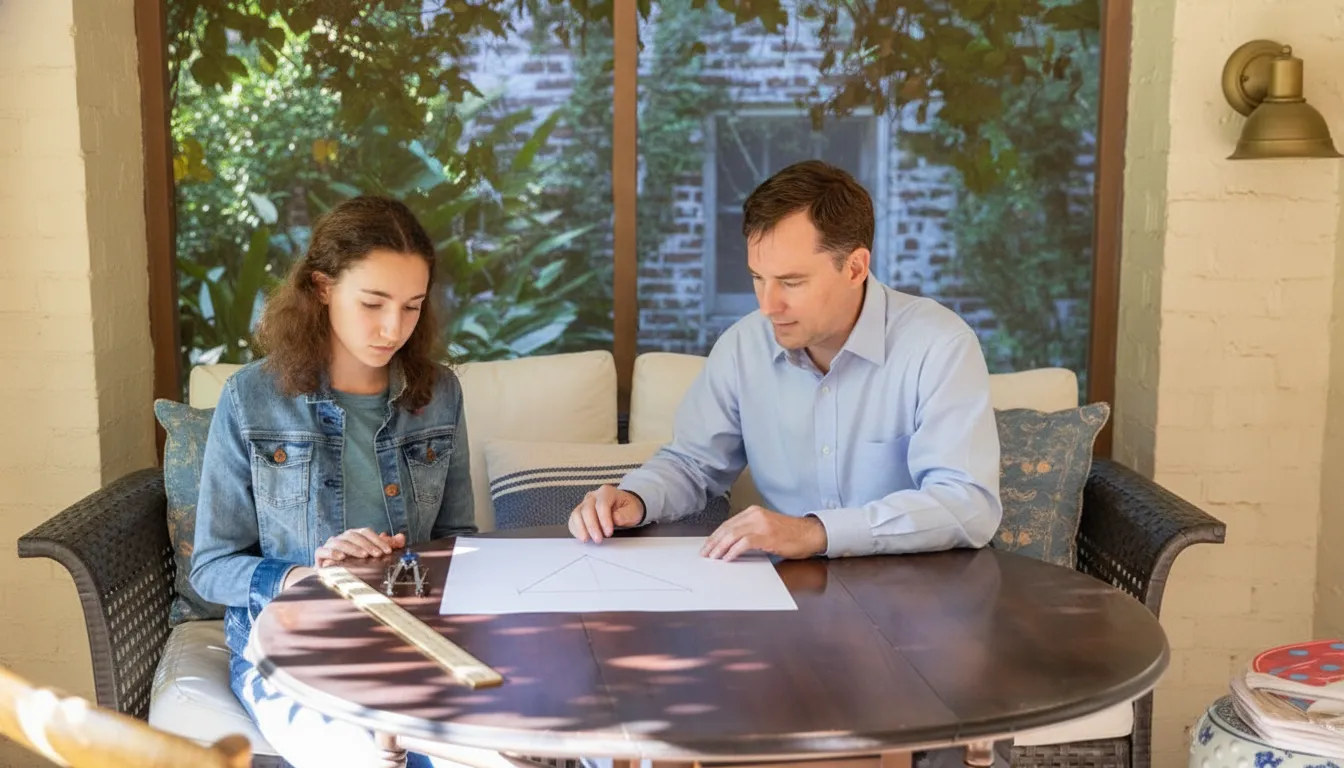
How Do You Write a Proof Without Getting Lost?
A geometry proof is a chain of defended claims. Every line needs a reason your child can name, and the final line must match the statement the problem requested. Students get lost when they accumulate correct facts that never actually reach the required statement.
Northside tutors teach proof writing as a short loop, not a memorized essay:
- State the given. Record only the facts stated in the problem or established earlier in the proof.
- Allowed move. Name the theorem and the specific condition that matches this figure.
- The new fact follows. Write the single conclusion that this justified move produces.
- Target check. Decide whether that line is the required prove-statement or merely a step toward it.
For math, Northside's test-prep method uses three questions. What information do I already have? What can I do with what I know? Does that answer the question? Those same three questions prevent a geometry proof from wandering away from the required target. The about page states them as a teaching method, not a score promise.
One justified line beats a page of unlabeled arrows. If your child cannot explain why a line is justified, that line does not belong in the proof.
Common breaks are easy to spot once someone else reads the chain. The student invokes corresponding angles without first establishing that the lines are parallel. The student establishes triangle congruence and then stops, even though the prompt requested a specific side length. The student treats the printed diagram as if it were drawn to scale. A tutor identifies the break immediately, then asks your child to repair that line before adding another one.
Classroom grading often scores only the finished proof. A tutoring session evaluates the decision that produced each individual line. That decision is the reasoning skill that transfers to the next figure, including items in SAT tutoring sets.
What Kind of Help Does Each Geometry Problem Need?
Not every stalled problem is a formal proof. Match the support to the actual job, or the hour is spent rehearsing an unrelated skill.
| The stuck point. | What your child is missing. | What the tutor does in the session. |
|---|---|---|
| Unmarked or messy diagram. | Givens are still in the paragraph, not on the figure. | Marks only given facts, then restates them in words. |
| Proof that stalls mid-chain. | A theorem is named without its condition. | Matches one theorem to the marks and writes one line. |
| Right answer, no reason. | The student guessed from the picture. | Requires a reason before the answer is accepted. |
| Word problem with a hidden figure. | The shape was never drawn. | Sketches the figure, then solves from the sketch. |
| Test item under a timer. | The method is fine and the pace is not. | Practices the same type with a short time box. |
Name the stall before you buy a full redo of the course. A diagram difficulty and a timed-test difficulty require different practice inside the same tutoring hour.
Geometry also prepares students for later mathematics courses. If the difficulty is really a triangle ratio, the more precise next page may be trigonometry tutoring, not more Euclidean proofs. If the difficulty is solving for a length after the figure is labeled, algebra tutoring may be the tighter fix. Name the pattern you see so the tutor match stays accurate.
On the SAT, College Board groups math into Algebra, Advanced Math, Problem-Solving and Data Analysis, and Geometry and Trigonometry. About five to seven questions in the Math section belong to that last category, and about 30 percent of Math questions use a real-world context. Those counts come from College Board's Math section overview. On the ACT, geometry accounts for about 17 to 20 percent of the mathematics section, including congruence, similarity, area, volume, and trigonometric ratios in figures. That reporting split appears on ACT's math test description.
Northside does not treat those published percentages as a promise of any score. They explain why a carefully read diagram still matters on test day. For SAT-style word problems, the SAT math question guide is the place to practice application items after the figure skills are secure.
What Happens in a Northside Geometry Session?
A session is one problem type, taught until your child can start the next one without a prompt. It is not a silent homework hour, and it is not a lecture covering every theorem in the chapter.
The shape follows the four-stage family process on Northside's about page:
- Assessment. The tutor finds where the work breaks: diagram, theorem choice, algebra cleanup, or pace.
- Tutor match. Your child is paired with a tutor for the goal and the specific way they get stuck. The match is based on the goal and the specific way your child gets stuck, not on a generic geometry label.
- Lesson plan. The plan names the figures and proof types for the following meetings, not a generic geometry review.
- Live adjustment. If frustration shows up, the tutor changes the question. A bored student and a stuck student do not get the same next step.
You should leave with a marked figure and a reason for each new line. If the notebook contains only a circled answer, the session skipped the reasoning.
Families can meet in person in Buckhead and Greater Atlanta, or online across the Southeast. Subject tutoring is one-on-one or in a small group. Current rates are on the pricing page: one-on-one subject tutoring is $150 an hour, and subject small-group tutoring is $95 an hour per student. Use that page for packages. This article will not shop rates for you.
Test-day geometry is a different product from weekly homework help. SAT, ACT, and SSAT plans, including a Score Boost Sprint close to an exam, are booked from the same pricing page. Start with ACT tutoring or SSAT tutoring only when the goal is the exam, not the class grade.
Across subjects, Northside tutors use a diagnostic, a short sequence, and guided practice. The math tutoring approach explains that method. Geometry adds the figure and the proof chain on top of it.
How Can You Tell the Help Is Working?
Ask for a change you can see in the notebook, not a mood report. After two or three sessions, your child should mark a new diagram before asking what to do, and should reject a theorem whose conditions do not match the marks.
Watch for these signs:
- They restate the givens without being asked.
- They write a reason beside the line, not after the teacher asks.
- They notice when a figure is not to scale.
- They can tell you whether the last line answers the asked question.
- Missed homework items cluster on one skill, not on "geometry" as a whole.
Progress is the next figure, started correctly without a hint. A higher report-card grade can follow that habit. A grade is not the only evidence, and it is not guaranteed.
Northside's public rule is that progress is measured from the start of the work to the end of it. The practice does not publish a score or grade claim as a promise. If a session is not producing a cleaner proof, say so. The instructional plan should change.
Parents often ask how this differs from a video or a solver. A video cannot see the illegal line your child just wrote. A solver can print steps and still leave the diagram unread. Use those tools when you want a second look. Use a tutor when the same mistake survives the video. The trial checklist for an online math tutor is there if you want a structured first meeting. For format, the online and in-person comparison is separate from this how-to.
When Should You Ask for Geometry Tutoring Help?
Ask when the same stall shows up twice, not after a single hard worksheet. Twice means a pattern. A repeated pattern is exactly what a tutor is for.
Good times to book:
- Proofs started this month and the reasons are missing or copied.
- Homework answers are right only when the figure is already marked by a teacher.
- A test is on the calendar and geometry items are the ones left blank.
- Your child can compute and still cannot draw the situation in a word problem.
Book a consult when you can name the stall in one sentence. "Proofs die after the given," or "diagrams are never marked," is enough to start. You do not need a unit-test average to begin.
Geometry tutoring help at Northside starts with that sentence. Send the stalled problem through the contact page. If you want the broader map of subjects first, the STEM tutoring guide and the math help guide sit beside this article. They do not replace a look at the actual figure.
Bring three things to the first meeting: the unmarked homework page, the class notes for that theorem, and one test item your child skipped. The tutor will mark, justify, and check. That sequence is the practical support.
Review geometry tutoring help before the questions below.
Frequently Asked Questions
Can someone help me with geometry proofs if I freeze on the first line?
Yes, a tutor can help with that freeze. Freezing on the first line usually means the diagram has not been translated into givens. A tutor marks only what the problem gives, says those marks out loud, and writes one legal line. You do not need a completed proof before the first session.
What should I bring to a geometry tutoring session?
Bring the stuck problem, the class notes for that theorem, and one skipped test item. A specific page is more useful than a request to review the whole chapter. The tutor uses the page to see whether the gap is the figure, the reason, or the algebra.
Does geometry help also cover SAT and ACT figures?
Yes, it can, once classroom proofs are stable. College Board lists Geometry and Trigonometry as its own Math category, with about 5 to 7 questions. ACT geometry is about 17 to 20 percent of the math section. Northside separates weekly subject help from a timed test plan, and neither plan promises a score.
Is a one-on-one session better than a small group for proofs?
Proofs are easier to repair one-on-one, because the tutor can stop on your child's illegal line. A small group works when several students miss the same diagram skill. Northside offers both. One-on-one subject tutoring is $150 an hour, and small-group subject tutoring is $95 an hour per student.
How is this different from searching for a geometry tutor?
Searching compares people, prices, and formats. This page is the work after you have a tutor: reading the figure, justifying the next line, and checking the asked question. Northside's hiring guides cover the search. Start here if the proof is already open on the desk.
Call (470) 779-8999 or book a geometry consultation and bring the diagram that stopped your child.
Ready to begin?
Start tutoring with Northside.