AP Biology Course and Exam Description
Get a clear AP Biology course and exam description, compare preparation formats, and build a focused study plan with support for your student.
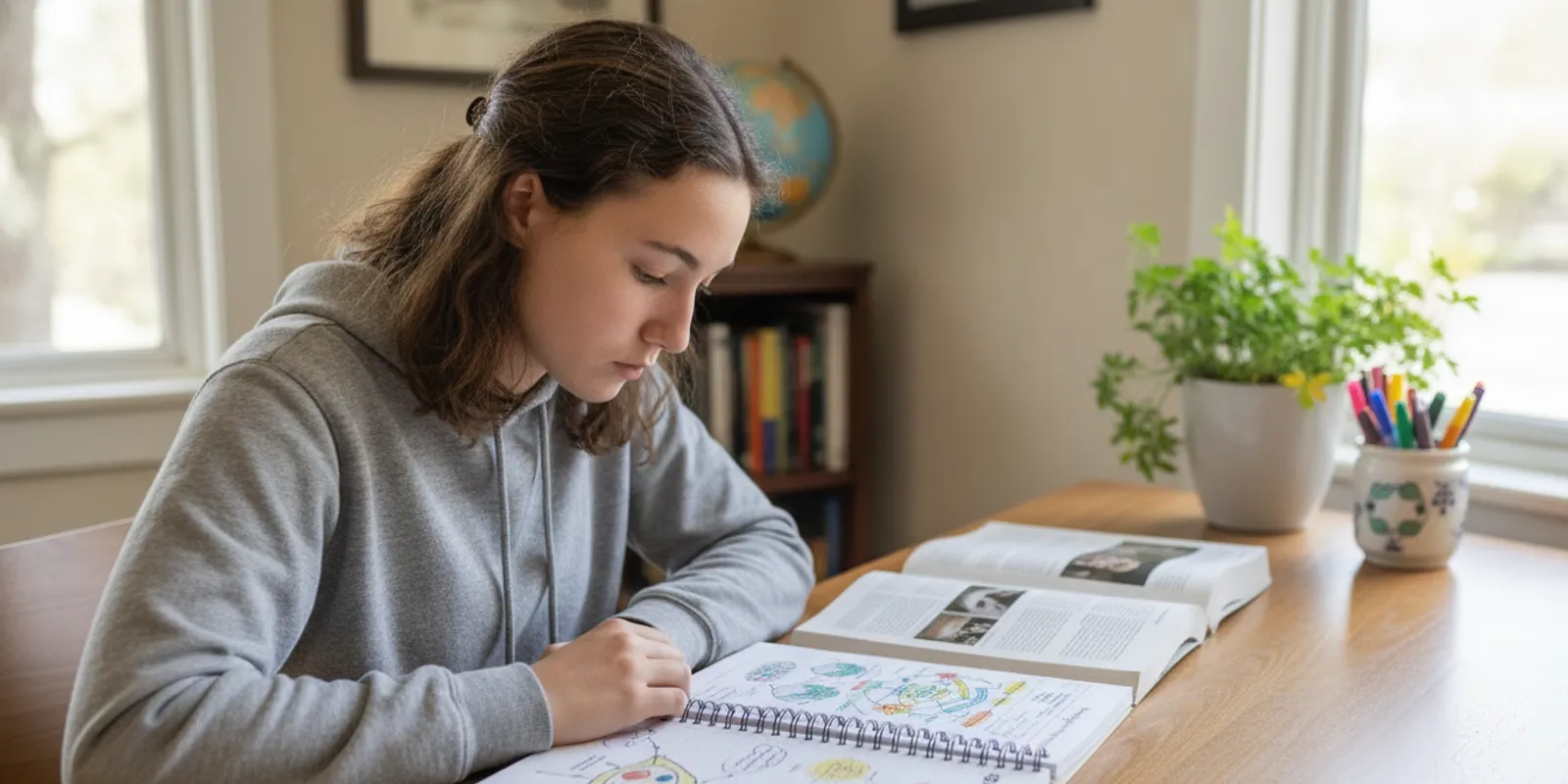
An AP Biology course and exam description is useful when it connects what your child learns in class with the reasoning the exam requires. AP Biology asks students to understand biological systems and use evidence, data, and scientific practices to explain them.
Talk with Northside about tutoring
What does the AP Biology course ask students to learn?
Short answer: Students study core biological ideas while learning to use them in explanations, investigations, and data analysis. The goal is not simply to recall vocabulary; students must connect concepts and support conclusions.
The College Board framework organizes learning around four recurring themes: evolution, energetics, information storage and transfer, and systems interactions. These themes appear across the course, so a question may require students to bring together material from multiple units rather than retrieve one isolated fact.
- Evolution: Explain how variation, inheritance, and reproductive success relate to changes in populations.
- Energetics: Describe how organisms obtain and transform energy, including through cellular processes.
- Information storage and transfer: Connect genetic information with its expression and inheritance.
- Systems interactions: Consider how components within organisms and ecosystems affect one another.
Course learning also involves interpreting representations such as graphs, models, and experimental results. A student studying cellular respiration, for example, may need to explain what a measured change suggests about a process, compare conditions, and state what the data cannot establish. Ask your child to explain not only what happened, but which evidence supports the explanation.
Teachers may arrange topics differently. The class syllabus, assignments, and teacher’s calendar are the best guides to the material being covered now. Families can learn about Northside’s test preparation tutoring, review resources for students and parents, and read the frequently asked questions when considering support.
How does the AP Biology exam test that learning?
Short answer: The exam includes multiple-choice and free-response tasks. Students need accurate biology knowledge, but they also need to interpret unfamiliar situations, analyze evidence, and communicate a reasoned answer.
The College Board AP Biology course page describes the course and its exam. The multiple-choice section includes individual questions and question sets. Free-response work calls on students to construct explanations, analyze data, and use scientific reasoning. Consult the current official course and exam description for timing and details for the student’s exam year.
Different prompts test different parts of the same toolkit. A student might know a concept yet struggle to identify a control, read a graph carefully, or justify a conclusion. During practice, have them underline the command verb, identify the evidence provided, and say how each sentence in the answer responds to the prompt.
| Task type | What the student does | Practice that builds the skill |
|---|---|---|
| Multiple choice | Selects the best answer, often from a scenario or representation | Explain why the best option fits and why another tempting option does not |
| Data analysis | Compares results and draws a conclusion supported by evidence | Describe the observed pattern before explaining its biological meaning |
| Experimental reasoning | Identifies variables, controls, or limits in an investigation | State what changes, what is measured, and what is kept consistent |
| Written explanation | Uses concepts and evidence to answer a prompt | Address every command and connect the evidence to the claim |
One practical self-check is to take a short set of mixed questions and label the kind of thinking each requires. If the student misses a question, ask whether the cause was missing content, difficulty reading the representation, confusion about experimental design, or an incomplete written response. This diagnosis is more useful than simply counting correct answers.
Use the official AP Biology materials for current course and exam guidance. Classroom directions still matter for local assignments and grading. Northside’s approach to tutoring can help families frame questions about how support might fit alongside class instruction.
How can your student turn course progress into a study plan?
Short answer: Start with a map of content and skills, use practice to identify specific gaps, and schedule repeated review. A good plan spends extra time where evidence shows a need without letting older topics disappear.
- Map the calendar. List units already covered, the current class topic, upcoming tests, and the expected exam date. Mark each area as secure, uncertain, or not yet learned.
- Check both knowledge and application. Include questions that test recall, graph interpretation, experimental reasoning, and written explanation. This reveals whether a content review alone would miss a skill gap.
- Keep an error log. For each missed item, record the prompt, the reason for the error, and a corrected explanation in the student’s own words. Note whether the issue was knowledge, reading, evidence selection, or response structure.
- Choose one correction action. Reread a relevant class section, redraw a process, explain a graph aloud, or answer a new question using the same skill. Avoid treating “review biology” as a specific action.
- Space and mix practice. Revisit earlier concepts briefly while studying current ones. Mixed questions require the student to decide which idea applies, rather than relying on the order of a chapter.
- Review the review. At the end of each week, look for recurring error types. Adjust the next week’s plan rather than repeating the same routine regardless of results.

A manageable weekly routine might pair one short recall session with a focused topic review, a mixed question set, and a review of written responses. The exact workload depends on the student’s course calendar and other commitments. Keep breaks and sleep in the plan; tired repetition is not the same as careful practice.
Consider a worked example. A question shows enzyme activity at several temperatures. The student first identifies temperature as the changed condition and activity as the measured outcome. Next, they describe the pattern in the results without jumping to a cause. Then they connect the pattern to enzyme function, while avoiding claims that the experiment did not test. If the question asks for a limitation, they might note that one set of conditions cannot establish how every enzyme behaves. This sequence turns a graph into a clear, evidence-based response.
Another example is a question about a population changing over time. The student should distinguish a change in individuals from a change in the population, identify which trait differences matter to the prompt, and use the evidence given to explain the trend. If the data only show a relationship, the answer should not claim that the investigation proved a particular cause. Precision about what evidence supports—and what it leaves open—is part of good scientific reasoning.
Students who want a general model for working through science problems can read this structured science problem-solving guide, while keeping AP Biology practice tied to biology course materials. Families may also browse the Northside article library and review current pricing information.
How should families compare AP Biology preparation formats?
Short answer: Match the format to the student’s learning gaps, schedule, and preferred amount of interaction. Independent practice, group instruction, and one-on-one tutoring each offer a different structure, so compare them by the work the student needs to do.
| Format | May suit a student who | Questions to ask |
|---|---|---|
| Independent study | Can set a routine and review errors reliably | Can the student identify a gap and choose a useful next step? |
| Group course | Benefits from a shared schedule and learning alongside peers | Does the pace leave room for questions and targeted practice? |
| One-on-one tutoring | Needs focused help with particular concepts or reasoning skills | How will instruction respond to class topics and practice results? |
| Combined approach | Needs a broad course routine plus targeted support | How will independent work and meetings reinforce each other? |
When comparing options, ask what the student will do between sessions and how progress will be reviewed. A useful plan makes the next action concrete: explain a process without notes, interpret a new data display, or revise a response to include evidence. Families can explore Northside tutoring locations, Atlanta tutoring information, and Buckhead tutoring. Students in nearby areas can see Sandy Springs tutoring and Roswell tutoring; families farther away can ask about online options through the consultation form.
Families may also consider Dunwoody tutoring, Alpharetta tutoring, or Johns Creek tutoring when looking at local arrangements. Compare based on practical access and the student’s actual work, not on a promise that one format suits everyone. Northside describes its test preparation support online; families can review the family perspectives with the understanding that another student’s experience does not predict your child’s.
Before choosing, bring a recent quiz, a sample response, and the course calendar to a conversation. Ask how a provider would use those materials to identify priorities and what a student should practice next. The FAQ page and student and parent resources can also help you prepare questions.
What should parents ask before selecting support?
Short answer: Ask how instruction will connect to your child’s actual coursework and practice needs. Look for a clear process, not a promised result.
- How will you identify content knowledge and scientific-reasoning gaps?
- How will sessions relate to current class topics and upcoming assessments?
- How will the student practice reading data and explaining evidence?
- How will you know when a plan needs adjustment?
- What should the student do between meetings, and how will that work be discussed?
- How will you coordinate with course materials without replacing the teacher’s directions?
A helpful conversation should leave the student with a specific next step and a reason for it. If the student struggles with a graph, for example, the next practice task might be to describe a trend, compare two conditions, and then write a claim that does not exceed the evidence. If content is the obstacle, the next task could be to draw a process from memory and explain each connection. Those differences matter: the study action should address the source of the difficulty.
Support should also encourage the student to take an active role. Ask them to explain what they tried, where they became uncertain, and what they would change next time. Treating an incorrect answer as information helps a student reflect rather than simply repeat an unsuccessful approach. Northside offers personalized tutoring; families can read about the company and its approach before deciding whether to ask about a fit.
Robert’s take: Start by finding the exact point where understanding or reasoning breaks down. Then help the student work through the idea, apply it to evidence, and explain the connection in their own words.
Families considering other forms of preparation can compare ACT tutoring, SSAT tutoring, or HSPT preparation as separate services, and browse Northside’s articles for study guidance.
Request a conversation about your student’s goals
Frequently asked questions about AP Biology preparation
Is AP Biology mostly memorization?
Students need accurate knowledge of biological concepts, but they must also apply ideas, interpret evidence, and explain reasoning. Memorization without practice using concepts in new situations may leave gaps.
Should a student study every unit equally?
Not always. Use class assessments and practice to find weak areas, give them extra attention, and continue brief review of earlier topics. Confirm priorities and coverage with the student’s teacher.
When should AP Biology preparation begin?
Build steady study habits during the course instead of waiting until the exam is near. The right schedule depends on the student’s course calendar, current understanding, and other responsibilities.
Can tutoring help if my student already earns good grades?
It may be useful for focused goals such as interpreting unfamiliar data, improving written explanations, or organizing review. A conversation can help determine whether targeted support makes sense.
Choose a next step your student can sustain
An effective plan links biology concepts with scientific reasoning and gives your child a repeatable way to learn from errors. Start with the class calendar and a clear picture of what feels difficult, then select a study format that fits the student’s needs and schedule.
Northside can discuss how personalized tutoring may fit your child’s goals and coursework. Contact Northside to talk through an AP Biology plan, and bring a recent assignment or practice question to make that conversation specific.
Ready to begin?
Start tutoring with Northside.